
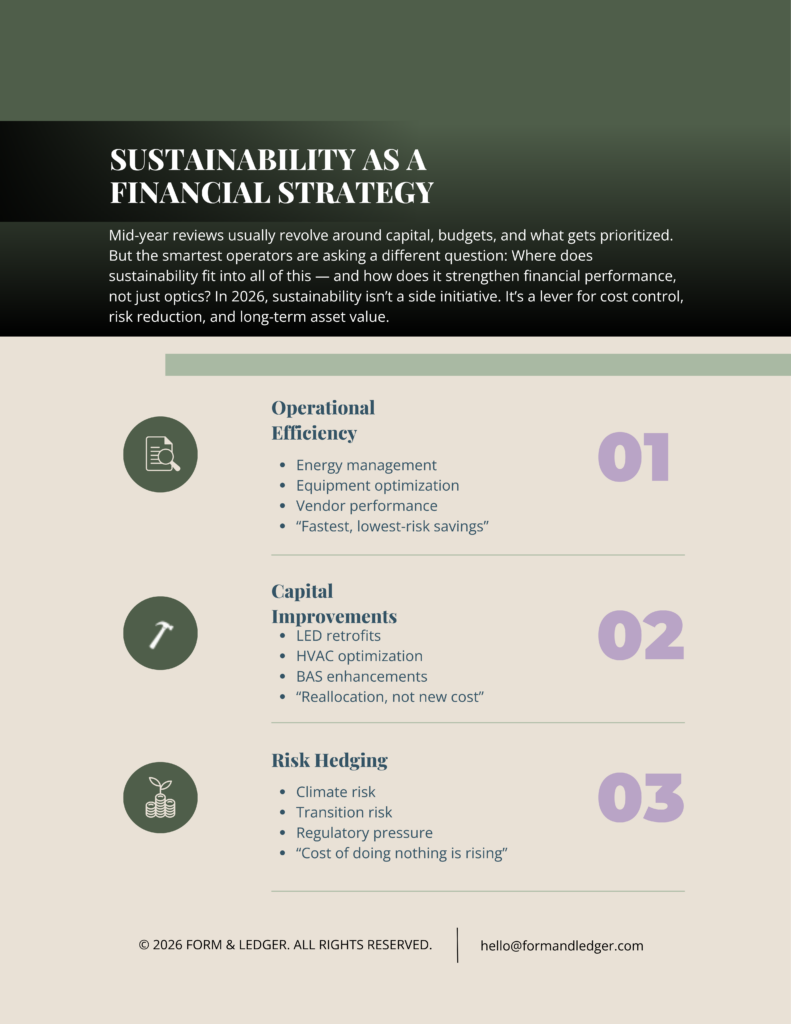
At mid-year, most conversations focus on capital, budgets, and project prioritization.
But the smartest operators are asking a different question:
Where does sustainability fit into all of this—and how does it improve performance, not just optics?
Because in 2026, sustainability is no longer a separate initiative.
It’s a lever for cost control, risk management, and long-term asset value.
Start with What Matters: Operational Efficiency
Before large capital projects, look at operations. This is the fastest, lowest-risk way to create impact.
Focus on:
- Energy management (controls, scheduling, real-time monitoring)
- Equipment optimization (run times, load matching, preventative maintenance)
- Vendor performance (are you paying for efficiency—or just service?)
These changes:
- Reduce expenses immediately
- Require minimal capital
- Improve your CAM position heading into 2027
No sustainability pitch required—this is just better operations.
Then Layer in Capital Improvements That Pay Back
Not all sustainability projects are expensive—and the right ones don’t feel like a cost.
They feel like reallocation.
Look for upgrades that:
- Reduce energy consumption
- Lower long-term operating costs
- Extend asset life
Examples:
- LED lighting retrofits
- HVAC upgrades or retro-commissioning
- Building automation system enhancements
- Water efficiency improvements
These projects don’t just “check a box.”
They:
- Improve net operating income (NOI)
- Stabilize future expenses
- Make your CAM more predictable and competitive
The Bigger Layer: Hedging Risk (Before It Shows Up)
Most pushback on sustainability comes from viewing it as optional. It’s not.
It’s a hedge against two very real risks:
1. Climate Risk (Physical)
- Rising temperatures
- Increased storm intensity
- Infrastructure strain
Ignoring this leads to higher maintenance costs, tenant disruption, and insurance pressure.
2. Transition Risk (Financial & Regulatory)
- Energy price volatility
- Evolving building standards
- Investor and lender expectations
Markets are already rewarding efficient buildings—and penalizing outdated ones.
The risk isn’t acting too early.
It’s reacting too late.
Where Deals Stall: Stakeholder Resistance
This is where most good ideas die. Not because they’re wrong—but because they’re framed incorrectly.
Common objections:
- “The payback isn’t fast enough.”
- “We didn’t budget for this.”
- “This feels like a ‘nice-to-have.’”
Reframe the Conversation
To gain alignment, shift how you present sustainability:
1. Lead with Financial Outcomes—not Environmental Language
Instead of:
- “This reduces carbon”
Say:
- “This reduces operating costs and protects NOI.”
2. Show the Cost of Doing Nothing
Frame the risk clearly:
- Higher future energy costs
- Competitive disadvantage in leasing
- Increased capital needs later
Inaction is not neutral—it’s expensive.
3. Tie It to Existing Priorities
Connect sustainability directly to the three mid-year focus areas:
- Defensive: Prevent system failures, reduce deferred maintenance
- Offensive: Attract tenants, support lease-up, improve building appeal
- Expense Reduction: Lower CAM, stabilize operating costs
Now it’s not a separate initiative—
it’s embedded into the strategy they already approved.
4. Start Small, Prove Value, Scale Fast
You don’t need full buy-in on day one.
- Pilot one building
- Track savings
- Use real data to expand
Nothing builds confidence like measurable results.
The Strategic Advantage
When sustainability is integrated—not bolted on—the benefits compound:
- Lower operating costs today
- More predictable budgets for 2027 and beyond
- Reduced exposure to energy and regulatory volatility
- Stronger asset positioning in the market
And most importantly:
- You maintain control over decisions, instead of reacting to pressure later
Final Thought
Sustainability isn’t about doing more.
It’s about doing smarter—with the resources you already have.
The question isn’t whether it fits into your mid-year reset.
It’s whether you’re willing to use it
as a tool to protect income, reduce risk, and drive long-term value.
© 2026 Form & Ledger. All rights reserved.